

Choosing a copper power cable for industrial loads is rarely a simple ampacity exercise. In practice, the right decision affects uptime, thermal stability, energy efficiency, maintenance cycles, and fault risk across the whole installation.
A cable that looks adequate on paper can still underperform when motors start hard, ambient temperature rises, routes become congested, or voltage drop limits are tight. That is why cable selection must connect electrical data with real installation conditions.
For industrial systems, a suitable copper power cable supports predictable operation over years, not just compliance at commissioning. The goal is to match conductor size, insulation, construction, and protection level to the load profile and the site environment.
Start with the load, not the catalog
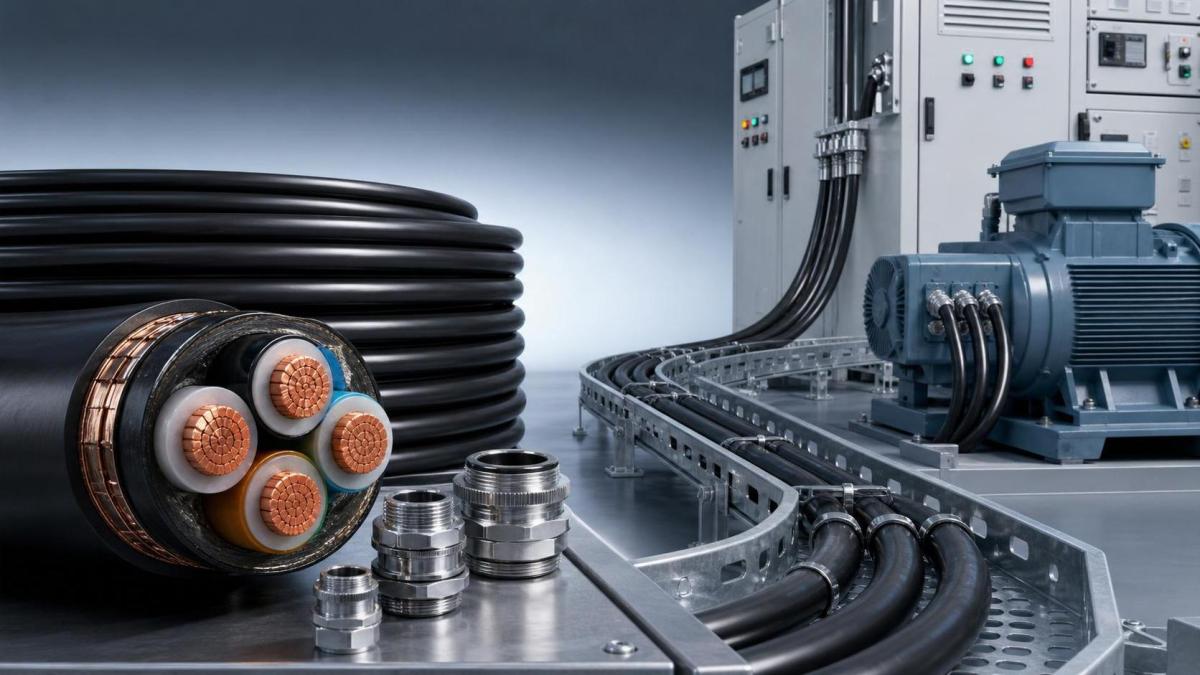
Industrial loads behave differently from one another, even at the same nominal current. Pumps, compressors, conveyors, heaters, UPS systems, and distribution feeders all stress a copper power cable in different ways.
Continuous current remains the first checkpoint, but it should never be the last. Starting current, duty cycle, harmonic content, and future load expansion often change the preferred cable size.
Motor-driven circuits deserve special attention. Repeated inrush current can elevate conductor temperature and influence insulation aging, especially where several cables share the same tray or conduit.
Where nonlinear equipment is present, neutral loading and heat buildup may also matter. In those cases, evaluating only the phase conductor current can leave hidden thermal margins unaddressed.
Key load questions before shortlisting cable types
- Is the load continuous, intermittent, or highly cyclical?
- Does the circuit feed motors, drives, heaters, or mixed equipment?
- What are the peak current and starting characteristics?
- Is capacity reserve needed for future expansion?
- Are harmonics or power quality issues expected?
Why copper remains a preferred conductor
Copper is widely selected because it combines high conductivity, mechanical strength, and stable long-term connection performance. In industrial settings, these qualities help reduce resistive loss and improve termination reliability.
A copper power cable also tends to perform well where space is constrained. Because copper carries current efficiently, it can support compact designs while maintaining acceptable electrical and thermal behavior.
This does not remove the need for careful sizing. Even with copper conductors, undersized cable can still cause overheating, nuisance trips, excessive voltage drop, and shortened insulation life.
More importantly, conductor material should be assessed together with insulation, sheath, core configuration, bending requirements, and ingress protection. Selection quality comes from the whole construction, not one attribute alone.
Cable sizing depends on more than current rating
Current carrying capacity is influenced by installation method, ambient temperature, grouping, soil conditions, and permissible conductor temperature. A copper power cable rated for one condition may require derating in another.
Voltage drop is another decisive factor. Long feeder runs, remote equipment, and high starting current can push voltage at the load below acceptable limits, even if ampacity appears sufficient.
Short-circuit withstand capability should also be checked. During a fault, the conductor and insulation must tolerate thermal and mechanical stress until protection devices clear the event.
The table below shows how common selection factors influence cable choice in practice.
Installation environment often decides the final choice
Industrial cable routes are rarely ideal. Some run indoors through trays, some pass outdoors under UV exposure, and others enter damp, dusty, or washdown areas where sealing performance becomes critical.
This is where insulation and sheath materials need closer review. PVC, XLPE, and other compounds differ in temperature resistance, flexibility, moisture behavior, and chemical tolerance.
If a circuit serves a building power station or a similar fixed distribution point, a robust multi-core option may simplify installation and protection planning. One example is Industrial Copper 4-core 150mm PVC Insulated IP67 Cable for Building Power Stations 0.6KV/1KV Rated Voltage, which reflects the kind of specification often reviewed for demanding fixed-power applications.
IP rating should not be treated as a minor detail. In wet or dusty areas, enclosure and cable interface protection affect service life almost as much as conductor sizing does.
Environmental checks worth making early
- Indoor tray, conduit, buried, or exposed outdoor route
- Expected moisture, dust, oils, or chemical contact
- Maximum ambient and surface temperatures
- Bending space at entry and termination points
- Mechanical impact or abrasion risk
Compliance, coordination, and documentation matter
A technically suitable copper power cable still needs to align with the project standard set. Local electrical codes, IEC requirements, fire performance rules, and site-specific specifications can all affect acceptance.
Termination compatibility is part of that review. Lug size, gland type, core identification, and equipment entry geometry should match the selected cable construction before procurement is finalized.
Protection coordination is equally important. Overcurrent devices should clear faults quickly enough to protect the cable, while the cable should withstand normal operating peaks without nuisance interruption.
Documentation quality often separates a smooth approval process from a delayed one. Data sheets, test references, conductor class, insulation details, and derating assumptions should all be easy to trace.
Where practical comparison creates better decisions
When two cable options both satisfy current rating, the better choice usually emerges from lifecycle considerations. Lower losses, easier installation, stronger ingress protection, or better thermal margin can justify a different specification.
For example, a copper power cable selected with extra room for voltage drop and grouping effects may reduce future retrofit pressure. That can be more valuable than choosing only the lowest acceptable size.
It also helps to compare cable options by system role. Feeders to distribution boards, connections to heavy motors, and power station links do not all reward the same design priorities.
In some reviews, a specification similar to Industrial Copper 4-core 150mm PVC Insulated IP67 Cable for Building Power Stations 0.6KV/1KV Rated Voltage may be relevant because it combines conductor size, multi-core layout, rated voltage, and environmental protection in one clear reference point.
A practical evaluation sequence
- Confirm actual load profile, including startup and diversity.
- Check installation method and apply all relevant derating factors.
- Verify voltage drop against route length and equipment tolerance.
- Review insulation, sheath, and ingress protection for the environment.
- Confirm short-circuit performance and protection coordination.
- Compare documentation quality before final approval.
What to carry into the next evaluation
The best copper power cable choice usually comes from disciplined comparison rather than a single headline specification. Current rating, route length, environment, fault level, and compliance all need to be read together.
A useful next step is to build a short comparison sheet for each candidate cable. Include conductor size, insulation type, derating assumptions, voltage drop, IP level, and termination compatibility.
That approach makes technical review more consistent and exposes tradeoffs early. It also helps ensure that the selected copper power cable supports stable industrial performance long after installation is complete.