

How to choose the right XLPE cable size? The answer affects safety, efficiency, voltage drop, and long-term system reliability. In power distribution and industrial applications, selecting the correct XLPE cable size requires evaluating current load, installation conditions, ambient temperature, and future capacity needs. This guide will help you understand the key factors and avoid costly sizing mistakes.
What Determines the Right XLPE Cable Size in Real Projects?
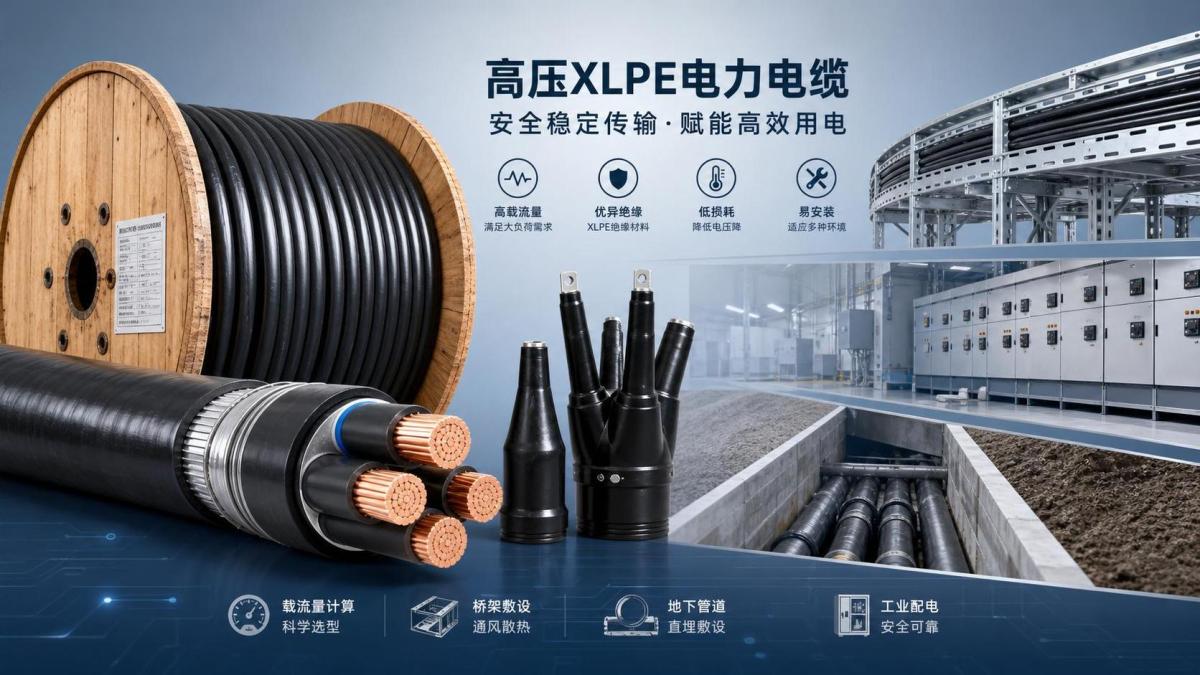
Many buyers ask, “How to choose the right XLPE cable size?” but the practical answer is never based on conductor cross-section alone. In cable and accessory projects, the correct size depends on electrical demand, installation method, insulation rating, route length, and the surrounding environment.
XLPE insulated cables are widely selected because cross-linked polyethylene offers strong thermal performance, stable dielectric properties, and good resistance to aging. These features support demanding industrial, utility, commercial, and infrastructure applications, but they do not eliminate the need for careful sizing.
The core selection factors
- Current-carrying capacity must match the real operating load rather than only the nameplate rating of connected equipment.
- Voltage drop must stay within the project limit, especially on long feeder runs or motor starting circuits.
- Short-circuit withstand capability matters where fault levels are high and protection clearing time is not extremely fast.
- Ambient temperature, soil thermal resistivity, grouping, and ventilation can reduce allowable ampacity significantly.
- Installation route, such as tray, conduit, duct, tunnel, direct burial, or indoor riser, changes heat dissipation conditions.
- Future expansion should be considered if the system will likely add more loads within a short planning horizon.
A common mistake is to select a cable only by matching the load current to a catalog value. That approach often ignores correction factors. In practice, derating can push an apparently suitable cable into an overloaded condition, increasing insulation stress and reducing service life.
How to Choose the Right XLPE Cable Size Step by Step
If your team needs a reliable selection path, the most efficient method is to follow a structured checklist. This helps purchasing staff, EPC teams, and maintenance engineers make consistent decisions and avoid ordering delays or costly rework.
A practical sizing workflow
- Define system voltage, phase arrangement, frequency, and whether the application is power, control, or auxiliary distribution.
- Calculate design current based on actual connected load, duty cycle, diversity, and motor starting behavior where relevant.
- Identify the installation method, including buried depth, tray configuration, conduit fill, grouping quantity, and ventilation conditions.
- Apply ambient temperature and grouping correction factors according to the relevant project standards or engineering practice.
- Check voltage drop over the full cable length, not just ampacity, especially for pumps, compressors, and remote distribution boards.
- Verify short-circuit withstand requirements for the conductor and screen where applicable.
- Review termination, jointing, bending radius, gland compatibility, and accessory selection before finalizing the cable size.
- Add reasonable spare capacity if the project is likely to expand and the cost of later replacement would be high.
This process gives a more accurate answer to “How to choose the right XLPE cable size?” than relying on one parameter alone. It also improves coordination between electrical design, procurement, site installation, and later maintenance.
Which Technical Parameters Matter Most?
Before comparing available sizes, it helps to organize the main technical variables that influence selection. The table below summarizes the most important parameters and shows how each one affects cable sizing decisions in cable and accessory applications.
This table shows why the answer to how to choose the right XLPE cable size must include both operating and fault conditions. In many installations, voltage drop or grouping derating becomes the real driver, not the nominal load current.
Why XLPE properties still need context
XLPE insulation generally supports higher conductor operating temperatures than many traditional insulation systems. However, a cable’s actual usable capacity still depends on conductor material, cable construction, sheath type, laying pattern, and national or project-specific standards.
For that reason, procurement teams should request complete technical data instead of comparing only cross-section numbers. Two cables with the same size may perform differently if installation assumptions are not the same.
How Installation Conditions Change XLPE Cable Size Selection
The same electrical load can require different XLPE cable sizes depending on where and how the cable is installed. This is one of the most overlooked issues during procurement, especially when the design team and purchasing team work from different assumptions.
Typical installation scenarios
- Direct burial routes can face poor soil heat dissipation, varying moisture, and thermal resistivity issues.
- Cables in conduit often run hotter because airflow is limited and heat is trapped.
- Multi-cable trays may create strong grouping effects, especially in compact industrial plants.
- Tunnels and utility galleries may offer good accessibility but can also have elevated ambient temperatures.
- Outdoor exposed runs may be affected by solar radiation, seasonal temperature variation, and mechanical support spacing.
If these conditions are not clarified early, the selected size may appear compliant on paper but perform poorly after installation. That leads to overheating, nuisance trips, reduced efficiency, and disputes over whether the cable or the system design is at fault.
Which XLPE Cable Size Fits Common Application Scenarios?
When buyers ask how to choose the right XLPE cable size, they often need a scenario-based reference rather than a purely theoretical explanation. The table below organizes common applications and the sizing priorities that usually matter most.
This kind of application mapping helps procurement teams talk more effectively with engineers and suppliers. It also speeds up quotation reviews because the cable size can be matched to the real operating scenario rather than a generic specification line.
Why Voltage Drop and Future Load Often Drive Upsizing
A cable may satisfy ampacity today but still be a poor choice if voltage drop is excessive. This is especially important in long cable routes, motor circuits, and systems with sensitive equipment. Low voltage at the load can reduce performance, increase current draw, and stress equipment during startup.
Future expansion is another major factor. Replacing undersized power cables after civil work, tray installation, and terminations are complete is expensive and disruptive. In many projects, moderate upsizing during the first installation lowers total lifecycle cost.
When upsizing is usually justified
- The cable route is long and the allowable voltage drop is tight.
- The installation area is hot, enclosed, or heavily grouped with other loaded circuits.
- The system may add motors, panels, or process loads within the next one to three years.
- The cost of future shutdown, re-pulling, or re-termination would exceed the extra material cost now.
That does not mean every circuit should be oversized. The goal is balanced selection: safe operation, acceptable losses, reasonable budget, and practical room for expansion where it truly matters.
What Should Buyers Check Before Ordering?
In cable and accessory purchasing, the wrong order is often caused by missing details rather than wrong intention. A well-structured procurement review reduces the risk of mismatched conductor size, sheath type, or accessory compatibility.
Pre-order checklist for XLPE cable size selection
- Confirm conductor material, such as copper or aluminum, because the same ampacity target may require different cross-sections.
- Verify voltage class, core configuration, armor requirement, and sheath type according to the installation environment.
- Check whether cable glands, lugs, joints, and terminations are available for the selected conductor size.
- Review drum length, transport limits, and site pulling conditions to avoid installation difficulties.
- Ask for technical confirmation on current rating assumptions, derating factors, and relevant standards used.
- Clarify lead time if larger or less common sizes require different production scheduling.
These checks are essential when answering how to choose the right XLPE cable size for real procurement. They connect electrical theory with delivery reality, which is where many projects either stay on schedule or begin to slip.
Standards, Compliance, and Engineering Coordination
XLPE cable sizing should always align with the standards and engineering rules used by the project. Depending on geography and application, teams may reference IEC-based practices, local electrical codes, utility requirements, or owner specifications. The key is consistency across design, procurement, and installation.
Why standards matter during selection
- Current ratings may differ depending on assumed installation conditions and reference temperatures.
- Short-circuit calculations depend on permissible conductor temperature rise and clearing time assumptions.
- Accessory compatibility depends on conductor size, insulation system, and voltage class.
- Inspection and acceptance often require documents that match the specified standard basis.
If one party sizes the cable using one set of assumptions and another party prices a different configuration, the result can be confusion, delays, or claims. Clear technical alignment is as important as the cable itself.
FAQ: How to Choose the Right XLPE Cable Size?
Is ampacity the only thing I need to check?
No. Ampacity is only the starting point. You also need to check voltage drop, short-circuit withstand, installation derating, conductor material, route length, and accessory compatibility. In many projects, one of these factors becomes the true reason for selecting a larger XLPE cable size.
Should I size for current load today or future expansion?
You should size for today’s verified load first, then assess whether future expansion is realistic and financially justified. If additional load is likely and cable replacement later would be difficult, planned upsizing can be a sound decision.
How do long distances affect XLPE cable size?
Long distances increase voltage drop and power loss. Even if the cable can carry the current thermally, the voltage at the receiving end may become too low. This is a common reason to increase conductor size in outdoor feeders, infrastructure routes, and remote industrial loads.
Can I simply replace copper with aluminum at the same size?
Not usually. Copper and aluminum have different conductivity, mechanical characteristics, and termination requirements. If switching conductor material, the cable size and accessory selection should be recalculated rather than copied directly.
Why Choose Us for XLPE Cable Sizing Support and Supply Coordination?
If you are still evaluating how to choose the right XLPE cable size, early technical confirmation can save both time and project cost. In cable and accessory sourcing, the most useful support is not generic sales language. It is clear discussion around load data, route conditions, voltage class, installation method, and accessory matching.
You can contact us to discuss practical selection topics such as conductor size confirmation, copper versus aluminum comparison, voltage drop review, installation derating assumptions, armor and sheath options, accessory compatibility, sample support, quotation details, and expected delivery time.
If your project has tight deadlines, uncertain specifications, or multiple installation environments, share the available parameters first. With the right inputs, it becomes much easier to recommend a suitable XLPE cable size and avoid repeated revisions during procurement and installation.